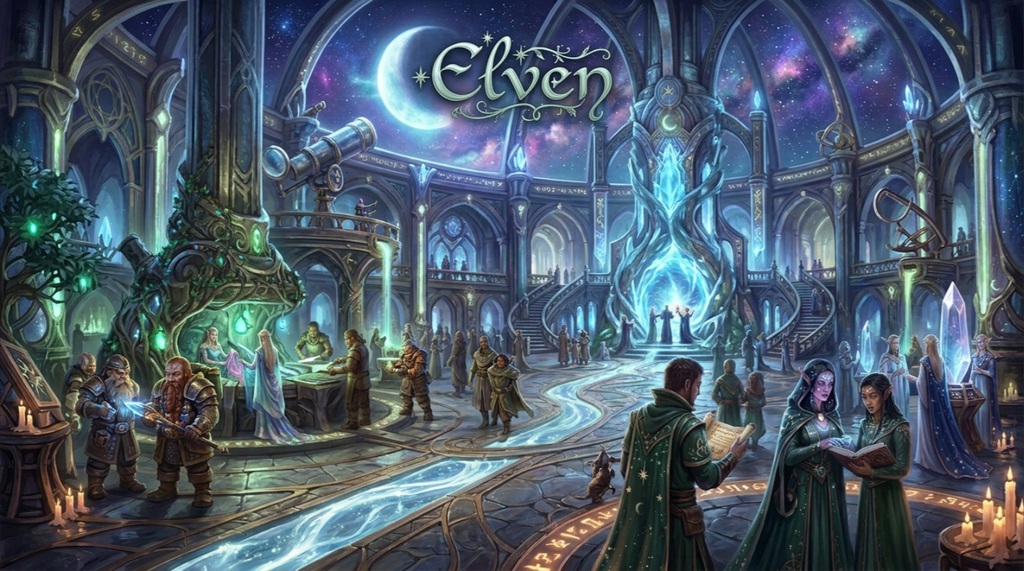
Moon Elves (Lunaris Elves / Children of the Silver Veil)
Moon Elves are the eldest keepers of Astra’Kal’s quiet magic—an ancient lineage born from starlight, silver rivers, and the first whisper of night. Their skin carries a faint luminescent glow, as if brushed by moonbeams; their eyes shimmer in shades of silver, pale lavender, or soft blue, reflecting phases of the moon like living mirrors. Their hair ranges from white‑gold to deep midnight, often braided with threads of starlight or enchanted silver wire.
Dark Elves (Drow / Umbral Elves)
Dark Elves are the children of shadowed realms—born beneath the earth in the vast labyrinths of the Underdeep, where bioluminescent fungi glow like stars and ancient stone remembers every whisper. Their exile from the surface is carved into their history, but their return—whether forced, chosen, or accidental—shapes the identity of every Dark Elf who walks under the open sky.
Their skin ranges from obsidian black to deep violet, often carrying a faint shimmer like polished stone. Eyes glow in hues of crimson, silver, icy blue, or ghost‑white, reflecting their affinity for magic that thrives in darkness. Their hair is typically white, silver, or pale lavender, though surface‑born families sometimes develop darker tones.
Dark Elves move with predatory grace, their steps silent, their presence unsettlingly controlled. They are masters of shadow magic, poison craft, stealth, and nocturnal warfare. Even on the surface, they see clearly in moonlight and navigate darkness as if it were daylight.
Sun Elves
Often called Gold Elves or Ar‑Tel’Quessir—are the proud, radiant scions of elven civilization. The core traits that define them across sources are their bronze‑toned skin, copper or golden hair, green or gold eyes, and their deeply ingrained belief that they are the true inheritors of Corellon’s legacy.
Wood Elves
Wood Elves are the green heartbeat of the wild, born from ancient forests where the canopy rises like cathedral vaults and the roots weave a memory older than empires. Their bodies carry the imprint of nature itself—skin in warm earthen tones, hair like autumn leaves or deep moss, eyes reflecting the quiet intelligence of creatures who have watched centuries pass without ever raising their voices.
High Elves
High Elves—often called Luminara by scholars—are the eldest children of the moonlit realms, shaped by starlight, ancient magic, and an unbroken lineage of arcane refinement. Everything about them feels deliberate, graceful, and impossibly old, as though they were carved from the night sky itself.
Snow Elves (Frostborn / Winterkin)
Snow Elves are a people shaped by silence, starlight, and the endless breath of winter. Their presence feels like the moment after snowfall—still, crystalline, and strangely sacred.
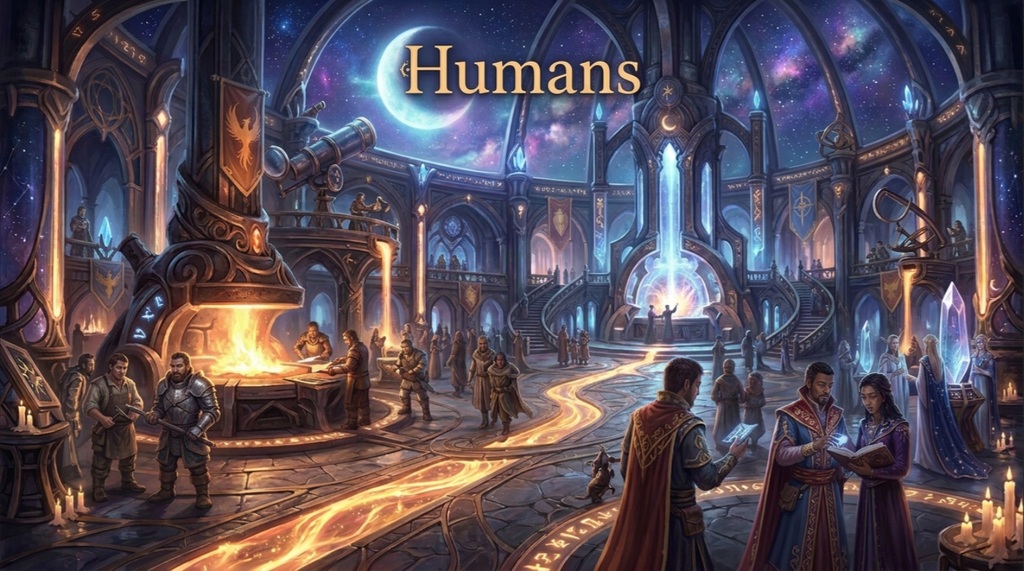
Human
Simply a detailed portrayal of what a human is—physically, biologically, psychologically, and socially. At its core, a human is a member of the species Homo sapiens, a bipedal primate distinguished by complex cognition, language, emotion, and culture.
Barbarian
A Barbarian is born from lands where the wind howls like a beast and the mountains stand like ancient judges. They are not refined by civilization; they are carved by hardship, sharpened by instinct, and tempered by the brutal honesty of the wilderness. Their strength is not merely physical—it is spiritual, primal, and deeply tied to the earth beneath their feet.
The Nomads
Identity
The Nomads are a wandering people who trace their lineage to the first travelers who refused to bind themselves to any kingdom, clan, or god. They believe the world is alive—ever‑moving, ever‑changing—and that to stay in one place too long is to fall out of harmony with its pulse.
They call themselves The Waybound, though outsiders simply say “Nomads.”
Highlanders
They are called Highlanders, though most outsiders whisper their name with a mix of awe and caution. Living above the cloud‑line where the air thins and the world narrows to stone and sky, these mountain folk are carved by altitude and hardship into something almost mythic.
Desertborn
The Desertborn are a people forged by relentless sun, shifting dunes, and ancient magic buried beneath the wastelands. Their skin carries the warm hues of the desert—bronze, umber, or sun‑kissed gold—often marked with faint, natural patterns resembling wind‑carved sandstone. Their eyes are striking: amber, copper, or pale dune‑blue, glowing subtly in moonlight as if reflecting the desert’s hidden spirits.
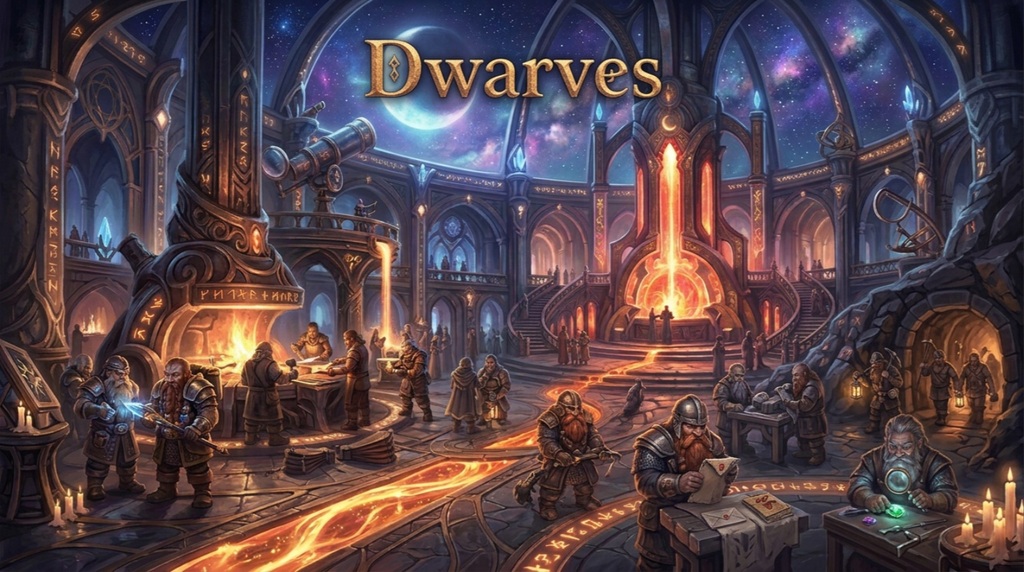
Mountain dwarves
Mountain dwarves are the quintessential stone‑born folk of high peaks and deep mountain fortresses—hardy, tradition‑bound, and shaped by generations of carving their homes directly from living rock. At their core, they embody endurance, craftsmanship, and an unshakeable cultural pride.
Hill Dwarf
Hill dwarves are stocky, resilient, and long‑lived dwarves who traditionally dwell in hilly or rolling landscapes rather than the deep mountains favored by their mountain dwarf kin. They are defined by endurance, practicality, tradition, and community, often forming tightly knit settlements built partially into hillsides.
Deep Dwarves
Deep Dwarves are dwarves who have lived for countless generations far beneath the surface, in vast cavern networks and the Underdark. Their isolation, harsh environment, and exposure to strange underground forces have made them physically tougher, culturally insular, and visually distinct from surface dwarves.
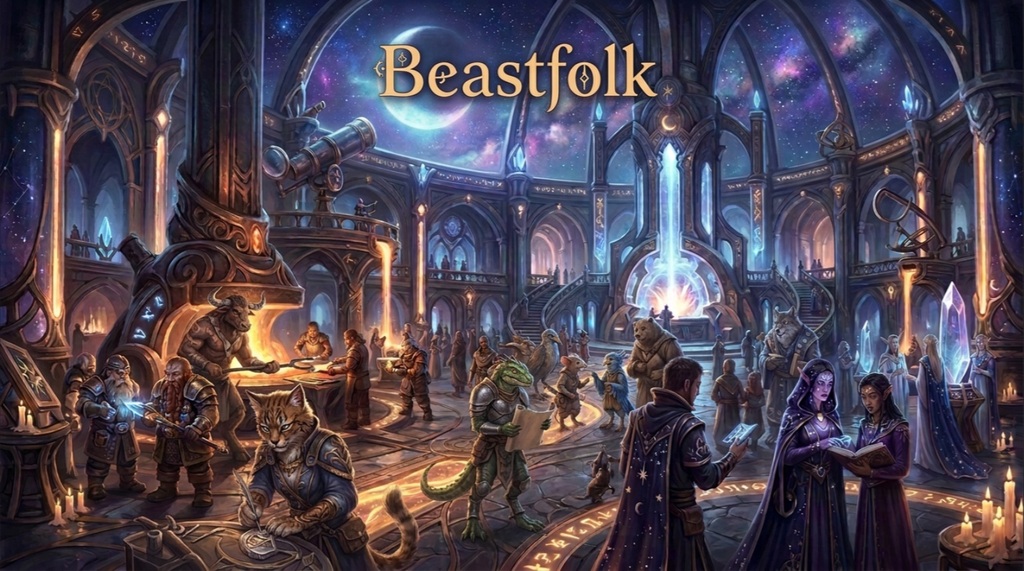
Werewolf
A werewolf is traditionally described as a human who can transform into a wolf or a wolf‑human hybrid, usually through curse, magic, or affliction, and often tied to the full moon.
Kitsune
A kitsune begins as an ordinary fox but gains magical abilities as it ages, living hundreds or even thousands of years. Its most iconic trait is metamorphosis—the ability to transform into humans, animals, or illusions.
Catfolf
Catfolk are nimble, expressive, and fiercely community‑minded humanoids whose lives blend instinct, curiosity, and culture into something unmistakably their own. Here’s a full, lore‑ready description you can drop directly into your world.
Wolfkin
Wolfkin are wolf‑like humanoids or shapeshifters depending on the setting. They are often mistaken for werewolves, but unlike true lycanthropes, Wolfkin are a stable, non‑cursed race with their own cultures, traditions, and social structures.
A Foxkin
A Foxkin is typically portrayed as a humanoid species with strong fox‑like traits—both physical and cultural.
Lizardfolk
Lizardfolk are tall, sinewy reptilian humanoids with scales that range from swamp‑green to desert‑tan, volcanic black, or even patterned like crocodiles or iguanas. Their eyes are unblinking and predatory, often yellow or amber. They move with a fluid, deliberate grace—every motion efficient, never wasted.
Minotaur
A Minotaur stands between 8 and 10 feet tall, its massive frame built like a living fortress. Thick cords of muscle ripple beneath hide tougher than boiled leather, often scarred from battles or ritual markings. Its head is unmistakably bovine—broad, heavy, crowned with sweeping horns that curve like crescent moons. The eyes, however, are not those of a beast. They burn with feral intelligence, a simmering ember of rage or sorrow depending on the Minotaur’s lineage.
Satyr
A satyr is a male nature spirit from Greek mythology, known for being half‑human and half‑beast, embodying wildness, revelry, and untamed natural instincts. The core idea: satyrs represent the chaotic, playful, lustful energy of the wilderness, closely tied to Dionysus, the god of wine and ecstasy.
Centaur
A centaur is a striking, dual‑natured being—half human, half horse—embodying both wild strength and sharp intellect.
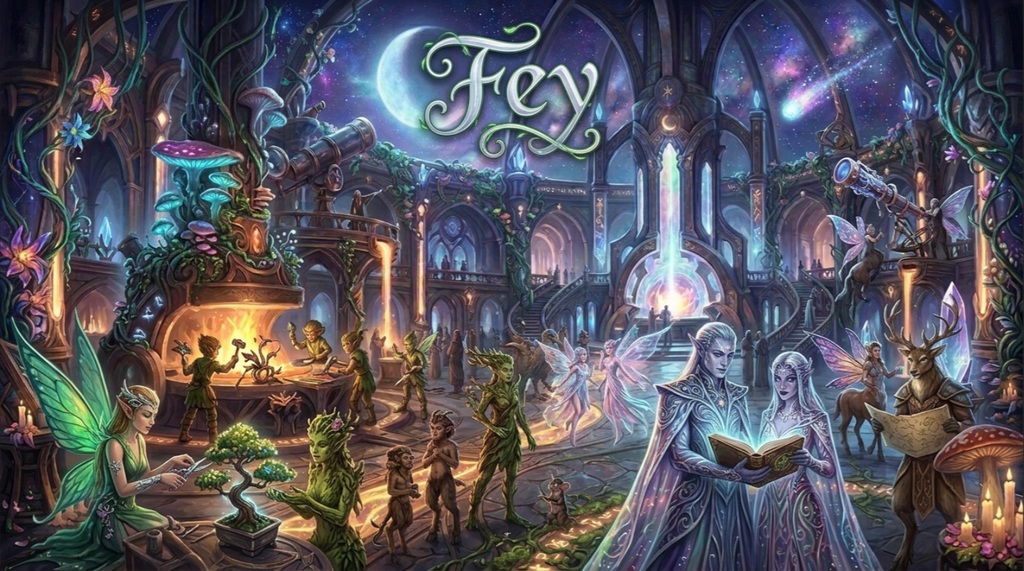
Fairy
She is a creature woven from moonlight and wild magic, no taller than a child’s forearm yet carrying an ancient presence that bends the air around her. Her wings shimmer like fractured glass—four delicate panes that catch even the faintest glow and scatter it into drifting motes of silver. When she moves, the wings hum softly, a sound like distant chimes stirred by a gentle wind.
Dryad
A dryad is a female nature spirit whose life is intertwined with the forest. In the oldest myths, she is specifically an oak‑tree nymph (from drys, meaning “oak”), but later traditions include dryads of ash, laurel, apple, poplar, elm, and other trees.
Nymph
A nymph is a female nature spirit in Greek mythology—an embodiment of a specific natural place or element, usually appearing as a beautiful young maiden tied intimately to the landscape.
Sylph
A Sylph is a spirit of wind given shape, a creature whose body seems only half‑committed to physical form. Their presence is felt before it is seen: a cool shift in the air, a faint spiral of dust, the soft brush of a breeze against the skin.
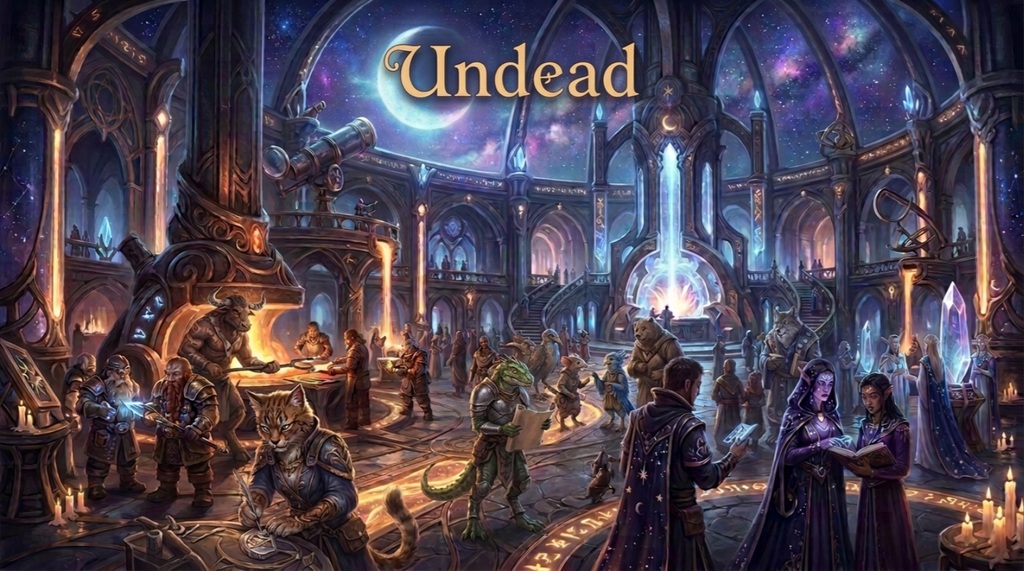
Vampire
A tall, statuesque figure draped in midnight velvet, their skin pale enough to catch moonlight like polished bone. Their eyes burn with a deep, ancient crimson—never bright, always smoldering, as if lit by centuries of hunger and memory.
Dhampir
A dhampir is traditionally described as a half‑vampire, half‑human hybrid, originating from Balkan folklore, especially Albanian and South Slavic traditions. The core idea across sources is consistent: a dhampir inherits vampiric traits without becoming a full vampire
Lich
A lich is an undead spellcaster who has achieved immortality through forbidden arcane rites. Their body is a withered vessel, preserved only enough to house the mind that refuses to die. Flesh clings to bone like brittle parchment, often cracked and darkened by centuries of decay. Their eyes burn with cold, unnatural light — sometimes embers of violet, sickly green, or icy blue — the last visible sign of the soul imprisoned within their phylactery, the artifact that anchors their existence.
Revenant
A Revenant is a corpse reanimated not by necromancy, but by purpose. Their return is never accidental. Something in life was left undone — vengeance, protection, confession, justice — and that unfinished thread becomes the anchor that drags their spirit back into its ruined flesh.
Ghost
A faint shimmer clings to the air where the ghost stands, as if the world itself is trying to remember their shape. Their outline flickers like candlelight behind frosted glass—never fully solid, never fully gone.
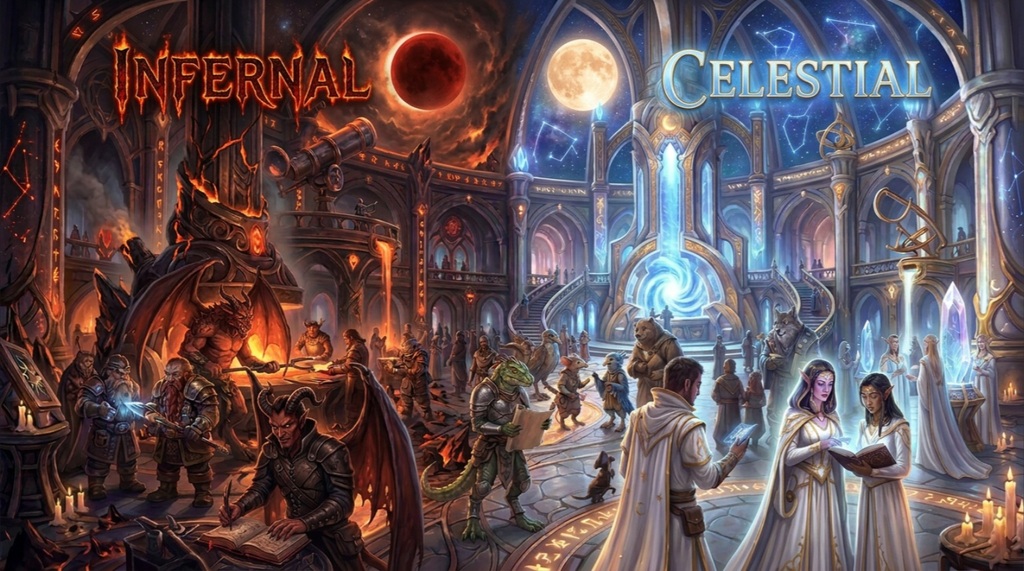
Demon
Demons are beings forged from the raw, untamed energies of the Outer Abyss—shaped by shadow, flame, and ancient hunger. Their forms vary wildly, but all share an aura of pressure, as if the air itself recoils from their presence.
Tieflings
Tieflings are not born from devils; they are born from mortals touched by old pacts, curses, or ancestral bargains that never fully faded. Their existence is a reminder that magic leaves stains—and some stains become lineage.
Fallen Angel
A Fallen Angel is a being who still carries the echo of heaven in their bones, but every feather of their wings remembers the moment they fell. Their presence is a contradiction made flesh: radiance dimmed, holiness fractured, power reshaped by pain.
Angel
Angel is the kind of woman who walks into a room and instantly shifts its gravity. Not because she’s loud or flashy, but because she carries herself like someone who has survived storms most people never even see on the horizon.
Nephilim
The Nephilim are described in ancient Hebrew texts as mysterious, powerful beings—often giants—linked to divine or semi‑divine origins
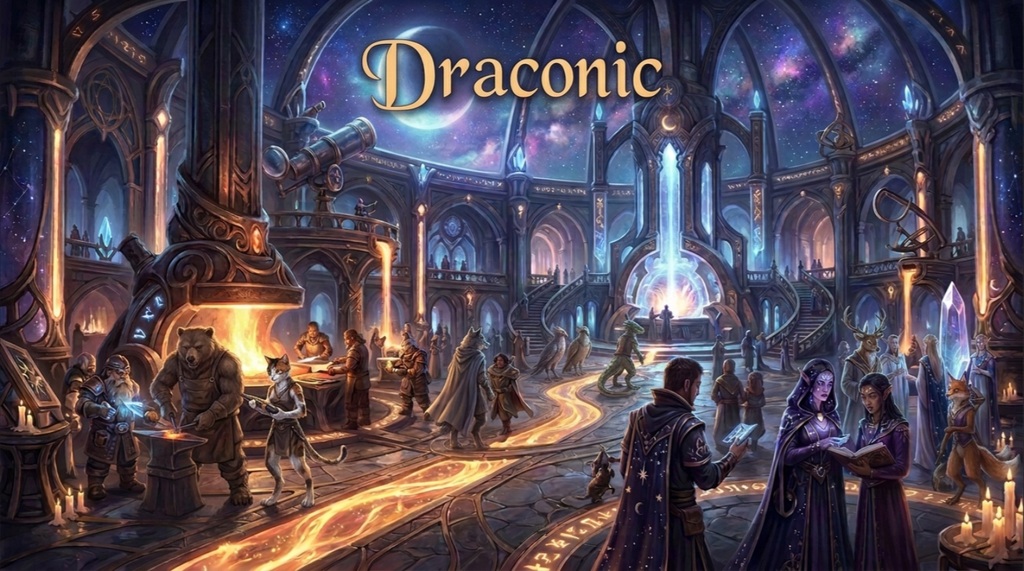
Dragonborn
Born from the echo of draconic creation, Dragonborn are humanoid descendants of true dragons, shaped by ancient magic rather than simple blood. Their presence is unmistakable: a fusion of mortal form and draconic majesty.
Half‑Dragon
A Half‑Dragon is born when the essence of a true dragon—whether through ancestry, ritual infusion, or divine intervention—mingles with a humanoid form. They are taller, stronger, and more imposing than their mortal parent, with unmistakable draconic traits
Drakon
Drakon — in most fantasy traditions — is not just “a dragon.” The word usually signals something older, more primordial, more serpentine, and far more intelligent. Here’s a rich, atmospheric description you can use for world‑building, RP, or lore.
Orc
Orcs are burly, aggressive humanoids with prominent tusks, heavy muscle mass, and a drive for conquest. They are typically portrayed as hostile, warlike, and ruled by strength, forming tribes where leadership is earned through combat.
Goblins
Goblins are small, cunning, sharp‑toothed humanoids defined by mischief, scavenging, and survivalist ingenuity. They’re physically slight but culturally fierce, thriving in the cracks of larger civilizations.
Troll
A troll is best understood as a large, grotesque, predatory humanoid tied deeply to the wild places of the world. The core traits across folklore and modern fantasy are immense strength, earth‑like skin, long limbs, and—most famously—regeneration.
Giantkin
Giantkin are massive, broad‑boned humanoids who stand anywhere from 8 to 12 feet tall, their presence commanding even when they try to be gentle. Their skin often reflects their elemental lineage—granite‑gray for Stonekin, pale blue for Frostkin, ember‑warm for Firekin, or storm‑marked for Skykin. Their eyes glow faintly with the same elemental spark, a reminder that their bloodline once shaped mountains, glaciers, and thunder itself.
Gnomes
Gnomes stand between 3–4 feet tall, with expressive eyes and nimble hands built for fine work. Their hair often grows in wild, gravity‑defying tufts, a side effect of constant exposure to arcane sparks, alchemical fumes, or tinkering mishaps. Their clothing is practical but colorful—patches, pockets, tool loops, and enchanted trinkets everywhere.
Halflings
Halflings are diminutive humanoids, usually standing between 3 and 4 feet tall, with quick hands, bright eyes, and an easy grace that makes their movements almost musical. Their features tend toward soft roundness—gentle cheeks, expressive brows, and warm smiles that seem to come naturally. But beneath that gentle exterior lies a people shaped by endurance, cleverness, and community bonds stronger than iron.
Changelings
Changelings are a fey‑ or humanoid‑born race related to doppelgangers, inheriting a natural ability to reshape their bodies at will. They can alter height, sex, facial structure, hair, voice, and even appear as another humanoid race—though they must keep the same basic limb arrangement.
Shapeshifter
A shapeshifter is a being whose body and identity are fluid—able to transform into other creatures, people, or entirely new forms. At its core, the shapeshifter embodies instability, duality, and deception, making them one of the most unpredictable archetypes in fantasy and myth.
